Saint Lestat
Blood CanticleSaint Lestat is Lestat’s imagined identity as a canonized saint: at once a grand public fantasy, a wish to serve God and relieve suffering, and a revealing contrast with his life as a vampire. He pictures a world that venerates him and turns to him for help, but the vision breaks apart before it can become reality. His longing resurfaces when he reflects on Juan Diego’s canonization, making sainthood both a personal desire and a question of how religious authority and public devotion create a saint.
The imagined saint
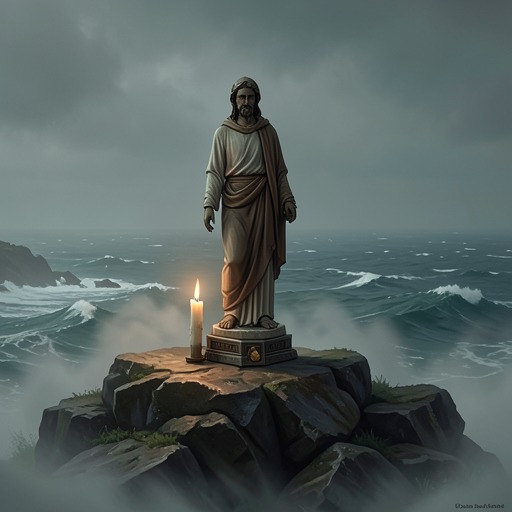
Lestat’s fantasy begins with an emphatic wish to be a saint and to save souls by the millions. He imagines a life-sized plaster statue of himself in every church: six feet tall, with glass-blue eyes and long purple velvet robes, its gently parted hands offering a focus for the faithful. The extravagant scale is part of the point. He does not imagine holiness as private virtue alone, but as a visible, worldwide presence that people can approach.
In this imagined devotional world, petitions range from illness and family trouble to addiction and pain. Lestat sees people carrying small statues of him to seminary doors in Mexico City, mothers praying before his image, and drug dealers in Bogotá laying down their guns. The image is credited with answered prayers and moral change; its devotees treat the saint as personally accessible, not merely as a name in church history.
The fantasy expands into an entire public culture of veneration. Lestat imagines hymns and pious poetry written about him, illustrated biographies printed by the billions, petitions left in a basket at St. Patrick’s Cathedral, and little likenesses placed in homes and workplaces around the world. His remains, in this imagined future, have become relics distributed in gold reliquaries, crosses, and lockets. He describes himself as aware of their influence and able to answer those who pray through them. The wish is not simply to be remembered: it is to remain present to people in distress and to make that presence effective.
A saint in the world and in the Light
The imagined Lestat is both a public figure and a soul with access to divine knowledge. He pictures himself in Heaven with God, possessing answers to every question, until God tells him that appearing to people is proper work for a great saint and what people expect of him. Lestat then descends toward Earth, accepting that some of his full understanding must be lost as he enters a world unable to grasp it. He describes himself as putting on his old human personality while preparing for an apparition. The scene turns the wish for recognition into a mission: sainthood would mean not only glory, but a responsibility to return to the suffering world.
That mission acquires a specific setting in his imagined visit to Pope John Paul II. The Pope greets him as Saint Lestat and asks why he has come rather than Padre Pio. Lestat takes the question as understandable rather than insulting. He notes the Pope’s love of Padre Pio and the many saints he has canonized, while admitting that, as he writes, his own canonization has not happened. In the fantasy, Lestat lays healing hands on the Pope and relieves his suffering. The encounter also lets him reflect on the Pope’s spirituality, shaped by life under Communism and the Second World War, and on the self-denial and sacrifice that Lestat sees as central to it.
Lestat uses the imagined audience with the Pope to argue that modernity need not be an enemy of faith. He calls Modernism and Materialism philosophically and practically young, and presents technological change as having spiritual as well as material possibilities. In his account, political atheism has failed, while Judeo-Christian expectations have become deeply embedded in secular Western life. He imagines technology and distribution alleviating poverty, communications weakening hatred, computer literacy helping minorities, and medical advances reducing the drug trade. He also argues that scientific knowledge of sexuality and reproduction should be embraced in the name of the Lord. This optimistic program makes the saintly fantasy more than a wish for personal elevation: Lestat imagines himself as a voice for a future in which material abundance and technological progress can serve spiritual and social aims.
The Pope listens and smiles, but the scene does not confirm Lestat’s authority. When the Pope jokes that he would laugh at Lestat if he were not a saint and asks when the Techno-saints will arrive, Lestat is pleased by the visit. He whispers that he will say hello to Padre Pio, only to find that the Pope has dozed off. The mismatch between Lestat’s sweeping vision and the Pope’s exhaustion punctures the grandeur without erasing the tenderness of the encounter: the Pope has traveled, suffered, and worked hard, and Lestat recognizes the limits of what his imagined audience can receive.
The vision’s collapse
After leaving the Pope, Lestat descends to the Sistine Chapel. In the imagined scene it is empty, dark, and cold; his saintly sight lets him perceive its magnificence. Alone, he longs to lie face down as a priest does at ordination, to become a priest and consecrate the host. The desire sharpens into a moral plea: he does not want to do evil. The chapel concentrates the fantasy’s religious stakes in a wish for participation in the Church’s sacred rites, not merely for the public honors of a saint.
But Lestat explicitly withdraws the scene from fact. His fantasy of Saint Lestat dissolves, and he acknowledges that he is not, and never was or will be, a saint. There was no banner bearing his likeness in St. Peter’s Square, no cheering crowd at his canonization, and no ceremony attended by cardinals. He has no harmless formula that can imitate addictive drugs and save the world, and he is not standing in the Sistine Chapel. The imagined religious pageantry gives way to his actual isolation elsewhere. By stating the negations one by one, the narrative makes clear that the supposed miracles, public recognition, and sacred setting belong to a wished-for story, not to events that occurred.
The decisive counter-image is Lestat’s actual condition. He has been a vampire for more than two hundred years, lives by blood, and understands himself as ritually impure. The saint who could answer every petition and relieve every pain is therefore set against a being who regards his own existence as a source of guilt. His fantasy does not remove that contradiction; it gives it a monumental form. The wish to be canonized and the wish not to do evil meet at the point where he confronts what he is.
That confrontation leads straight back to the Dark Trick, the one kind of miracle Lestat says he can work. His sense of guilt does not stop him from proceeding. The movement from imagined sainthood to vampiric action is the expression’s central reversal: the hoped-for saint cannot rescue the world through universal healing, so Lestat returns to the supernatural power actually available to him. The fantasy has not made him holy, but it has exposed the ethical longing against which he measures his choices.
Canonization, envy, and recognition
Lestat’s desire for official recognition returns when he reflects on Pope John Paul II’s canonization of Juan Diego. He is moved by the account of the Indigenous man to whom Our Lady of Guadalupe appeared in 1531. According to the story Lestat recounts, a local Spanish bishop initially ignored Juan Diego’s report; the Virgin then provided red roses growing in snow, and Juan Diego opened his tilma to reveal an image of the Virgin Mary. Lestat notes that the cactus-fiber garment, bearing the image, still hangs intact in the Cathedral in Mexico City and draws thousands of visitors. The story’s combination of religious testimony, a reported miracle, an enduring sacred image, and popular devotion offers a concrete contrast to his invented relics and imagined canonization.
Lestat does not treat uncertainty about Juan Diego’s historical existence as sufficient to cancel the religious meaning of the canonization. He argues that the Pope’s authority remains consequential even if critics cannot establish whether Juan Diego existed. More importantly to Lestat, the saint’s status has practical consequences in the spiritual world he imagines: Juan Diego is likely to receive petitions from Indigenous people and descendants of colonists and to carry them toward God. Lestat pictures him listening to human suffering and acting as an intermediary. The imagined work of sainthood is therefore not simply a reward after death; it is a continuing service to the faithful.
The contrast makes Lestat’s envy explicit. He notes that Pope John Paul II has canonized 463 saints in his lifetime and wishes he were among them. He suspects this desire may be why he had to write the chapter, then immediately insists that he is not a saint and admits that he cannot forget his passion to be officially canonized. The expression holds together both sides of his self-presentation: the exuberant Saint Lestat who imagines a world organized around his intercession, and the vampire who knows that no canonization has taken place. Its force lies in the gap between them, where the longing to help, the hunger for recognition, and the awareness of moral failure remain unresolved.